
CIRCULAR ECONOMY ACT: A STRATEGIC OPPORTUNITY FOR NON-PACKAGING AGRICULTURAL PLASTICS
The upcoming EU Circular Economy Act (CEA) is a decisive moment for Europe’s plastics and agriculture sectors.
For APE Europe, the priority is clear: non-packaging agricultural plastics must be fully integrated into Europe’s circular economy framework.
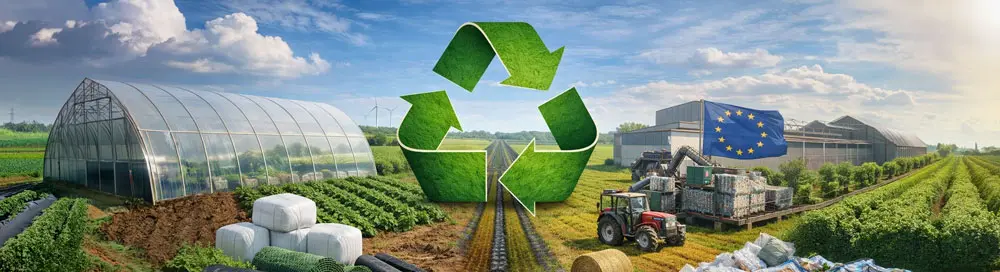
Essential materials for modern agriculture
Non-packaging agricultural plastics – such as mulch films, greenhouse covers, silage films, nets, twine and irrigation pipes – are critical to modern farming systems.
They enable:
- Higher productivity
- More efficient use of water and inputs
- Greater resilience to climate change
The question is not whether to remove them. The challenge is to make their use fully circular.
A structural gap: fragmentation and free-riding
Today, the management of non-packaging agricultural plastics in Europe remains fragmented.
Across Member States:
- Collection and recycling systems are uneven or absent
- Some actors place products on the market without contributing to end-of-life management
This leads to:
- Unfair competition
- Underperforming systems
- Loss of credibility for circularity efforts
Without correction, this fragmentation will lead to inefficient and overly rigid regulation.
No circularity without systems
APE Europe calls for the deployment of National Collection and Recycling Systems (NCRS) for non-packaging agricultural plastics in every Member State.
The objective is to:
- Scale proven national models
- Ensure full participation of all producers
- Eliminate free-riding
- Create a level playing field across the EU
Towards a coherent European framework
To unlock circularity at scale, the Circular Economy Act must deliver:
- Reliable monitoring and traceability of materials placed, collected and recycled
- Harmonised end-of-waste criteria to enable a true single market for secondary raw materials
- Performance-based systems, with eco-fees reflecting real operational costs
A shared responsibility across the value chain
Circularity requires a system approach:
- Farmers prepare and return used plastics
- Distributors facilitate collection and logistics
- Producers finance systems and design for recyclability
This shared model ensures fairness, efficiency and long-term sustainability.
Investment and market conditions are critical
Achieving circularity will require:
- Investment in collection, sorting and recycling infrastructure
- Support for innovation and advanced recycling technologies
- Mechanisms to ensure stable markets for recycled materials
Without a viable market for recyclates, circularity cannot scale.
A pragmatic, evidence-based approach
Policy decisions must be grounded in evidence. Current data indicates that non-packaging agricultural plastics are not the primary source of microplastics in soils, compared to other sources such as sewage sludge or urban residues.
The focus should therefore be on:
- Improving collection and handling practices
- Reducing leakage
- Scaling effective solutions
A strategic choice for Europe
The Circular Economy Act is an opportunity to move from fragmentation to coherence.
Europe can:
- Build a functioning system for non-packaging agricultural plastics
- Strengthen both environmental performance and competitiveness
- Create a credible circular economy model at scale
Non-packaging agricultural plastics are not the problem – they are part of the solution.
You can access our full contribution to the public consultation in PDF format here: [APE Europe – public consultation on CEA 06.11.2025].